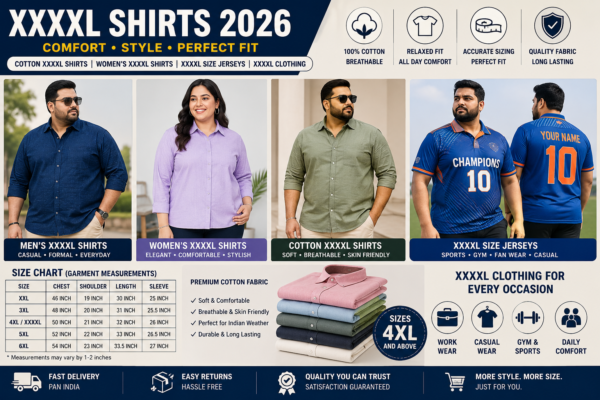
XXXXL Shirts in 2026: A Complete Guide to Cotton XXXXL Shirts, 4XL Clothing, Women’s XXXXL Shirts and XXXXL Size Jerseys
The demand for XXXXL shirts and other plus-size clothing has become increasingly visible in 2026, particularly as shoppers look for clothing that combines adequate room, modern styling, breathable fabrics, and dependable sizing. Terms such as “XXXXL shirts,” “XXXXXL shirts,” “cotton XXXXL shirts,” “4XXXXL shirts,” “women’s XXXXL shirts,” “XXXXL clothing,” and “XXXXL size jerseys” are increasingly used by shoppers searching for garments that go beyond the conventional XL and XXL ranges. The important point, however, is that XXXXL is not a universally standardized measurement. A garment labeled XXXXL by one manufacturer can have substantially different chest, waist, shoulder, sleeve, or overall-length measurements from another. Current Indian retail listings demonstrate this variation clearly: for example, one women’s cotton shirt listing describes 4XL as a 50-inch garment bust, while another cotton plus-size T-shirt lists 4XL at a 46-inch garment bust.
For this reason, anyone searching for XXXXL shirts in 2026 should treat the “XXXXL” label as a starting point rather than the final measurement. The most reliable way to purchase a large-size shirt is to compare the garment’s actual measurements with a shirt that already fits well. Chest measurement is particularly important, but it should not be considered in isolation. Shoulder width, sleeve opening, shirt length, waist or belly circumference, armhole depth, and the intended fit all influence whether a shirt feels comfortable. A person may technically fit into a particular XXXXL chest measurement but still find the garment uncomfortable because the shoulders are narrow or the sleeves are restrictive. This is one reason size and fit remain significant problems in online fashion purchasing, where customers cannot physically try garments before ordering. Research on fashion e-commerce has specifically identified size and fit as important contributors to clothing returns.
Cotton XXXXL shirts are particularly attractive for people who prioritize comfort and breathability. Cotton is widely used in casual and everyday shirts because it generally feels comfortable against the skin and works well in warm conditions. For larger garments, fabric selection becomes even more important because the wearer may spend long periods in the shirt and may prefer materials that do not feel excessively heavy or restrictive. Current Indian retail listings show that cotton options are available in extended sizes, including women’s 4XL and beyond, although the exact size availability varies substantially by brand and product.
A good cotton XXXXL shirt should not simply be a smaller design scaled upward. Pattern construction matters. When a shirt is enlarged without appropriately adjusting the proportions of the shoulders, armholes, sleeves, torso, and hem, the resulting garment can feel uncomfortable even when its chest measurement appears sufficient. A well-designed plus-size shirt should distribute additional fabric intelligently across the body rather than merely becoming wider. This is especially important for people who carry more volume around the abdomen, chest, or upper arms. Some specialist Indian shirtmakers are now explicitly marketing extended-size construction and belly-fit designs, with certain suppliers advertising custom measurements and garments extending to very large chest or waist dimensions.
The expression “XXXXL shirts” is also used differently across the clothing market. In some stores, XXXXL corresponds to 4XL, while other sellers use 4XL, XXXXL, or even numerical size systems interchangeably. This makes shopping by label alone unreliable. A customer searching for “4xxxxl shirts” may therefore encounter products that are not equivalent in actual dimensions. The safest approach is to search using several terms, including XXXXL, 4XL, 4X, plus size, big size, extended size, and the desired garment type, and then verify the individual product’s measurement chart before purchasing.
The same principle applies to XXXXL clothing more broadly. The market for extended-size clothing is no longer limited to oversized basic T-shirts. Shoppers can find shirts, T-shirts, casual tops, trousers, jerseys, sportswear, and other garments in extended sizes, although availability differs considerably between categories and brands. Some Indian online fashion listings currently extend well beyond 4XL. For example, one women’s cotton T-shirt listing offers sizes from M through 8XL, while another women’s cotton top listing extends from XXL through 10XL. This illustrates an important change in the extended-size market: consumers should not assume that XXXXL is necessarily the largest available size.
Women’s XXXXL shirts deserve particular attention because women’s sizing can vary even more dramatically between brands and garment styles. A women’s 4XL shirt can have a completely different bust measurement from a men’s 4XL shirt, and the cut may also account for differences in waist shaping, hip coverage, sleeve design, and overall length. A current Indian listing for a women’s plus-size cotton casual shirt, for example, offers 4XL with a stated 50-inch garment bust and 5XL with a 52-inch garment bust. Another women’s cotton T-shirt listing uses 4XL at 48 inches and 5XL at 51 inches, demonstrating why the individual garment’s chart is more useful than assuming a universal 4XL standard.
For women looking for XXXXL clothing, the intended silhouette is also important. A regular-fit shirt may provide less room around the stomach and upper arms than a relaxed or oversized design. A longline shirt can provide additional coverage, while a curved hem can create a different visual proportion from a straight hem. Button-down cotton shirts can be useful for workwear and everyday wear, whereas oversized printed T-shirts may be more appropriate for casual outfits. Current plus-size listings include relaxed-fit and longline designs, showing that extended sizes are increasingly being incorporated into different clothing silhouettes rather than being restricted to one basic shape.
Color and pattern selection can also make a significant difference in how XXXXL shirts are perceived and worn. There is no requirement that plus-size clothing should be limited to dark colors or plain fabrics. Modern XXXXL clothing can include stripes, checks, florals, prints, textured fabrics, embroidery, and other contemporary styles. Large-size shoppers should choose patterns according to personal preference and occasion rather than assuming that only certain colors or designs are suitable. Major retail collections currently include extended-size shirt categories featuring multiple colors and patterns, demonstrating the broader variety available in the market.
When buying cotton XXXXL shirts, fabric composition deserves as much attention as the size label. “Cotton” can refer to garments with different constructions, weights, finishes, and blends, so shoppers should read the product specifications carefully. A lightweight cotton shirt can be preferable in hot weather, while a heavier cotton fabric may work better for structured casualwear. Cotton blends can sometimes provide additional stretch or easier maintenance, but the actual composition should be checked rather than inferred from the product title. Care instructions also matter because repeated washing, drying, ironing, and exposure to heat can influence the garment’s appearance and dimensions over time.
The phrase “XXXXL shirts 2026” is particularly relevant because extended-size fashion is increasingly moving toward a broader understanding of fit rather than simply adding larger labels to standard garments. Current Indian retail and specialist-brand offerings demonstrate that XXXXL and larger sizes are available across different styles, although the consistency of sizing remains an issue. Levi’s India, for example, currently maintains a dedicated XXXXL shirt collection for men and women, while specialist sellers advertise even larger custom-size options. The availability of such collections makes it easier for consumers to search specifically for extended sizes instead of relying exclusively on generic “oversized” clothing.
XXXXL size jerseys are another important category, particularly for cricket, football, basketball, gym wear, fan apparel, and casual sports fashion. Jerseys are often designed with a looser silhouette than formal shirts, but that does not mean every jersey labeled XXXXL will fit the same way. A sports jersey may be intentionally loose, while a replica jersey may follow a more athletic cut. This distinction becomes especially important for larger body types because an athletic-fit jersey can feel significantly tighter around the chest, stomach, or arms than a relaxed-fit jersey with the same nominal size.
For XXXXL jerseys, shoppers should pay attention to whether the measurement chart refers to body size or garment size. A body measurement tells you the approximate dimensions of the wearer, whereas a garment measurement tells you the actual dimensions of the finished jersey. These are not interchangeable. A jersey with a 52-inch chest measurement, for example, will not necessarily be suitable for someone whose body chest measurement is exactly 52 inches if the garment is designed with minimal ease. The amount of extra room required depends on the intended fit and the construction of the garment.
The material of a XXXXL jersey is also important. Sports jerseys frequently use synthetic performance fabrics because they are designed to be lightweight and suitable for physical activity. Cotton jerseys and cotton-blend jerseys may feel different and can be preferable for casual wear rather than intense sports. Buyers should therefore distinguish between a jersey intended for actual athletic activity and one designed primarily as fan merchandise or streetwear. Oversized sports jerseys have also become a fashion category in their own right, with consumers wearing them as casual tops rather than strictly as sports uniforms.
One of the biggest mistakes when buying XXXXL shirts online is assuming that a larger size automatically means a longer garment. Width and length are separate dimensions. Someone with a larger chest or waist may still need additional shirt length, particularly if the shirt is intended to be worn untucked. This is why tall or broad-bodied shoppers should check both chest and length measurements. Sleeve length can be equally important, particularly in full-sleeve shirts. A shirt can have adequate chest room but still have sleeves that are too short.
Another common mistake is confusing “oversized” with “plus size.” An oversized shirt is intentionally constructed with additional ease and a loose silhouette, whereas a plus-size garment is designed around larger body proportions. An oversized XL shirt may be wider than a regular XL but may still have shoulders, armholes, and sleeve proportions that do not work well for every larger body type. Conversely, a properly patterned XXXXL shirt may look more structured and comfortable despite not appearing extremely oversized. For shoppers seeking genuine comfort, the distinction is worth understanding.
The availability of XXXXL clothing has also become increasingly important for online shoppers because physical stores do not always carry the complete extended-size range. Online retailers can provide access to specialist plus-size brands and extended-size collections that may not be available locally. However, online convenience comes with the responsibility of checking measurements, fabric details, return policies, customer reviews, and product photographs carefully. Reviews can be particularly useful when they contain comments about whether the garment runs small or large, whether the sleeves are comfortable, and whether the fabric behaves as expected after washing.
There is also a growing movement toward greater size inclusivity in fashion. Extended-size customers increasingly expect the same variety of colors, prints, cuts, fabrics, and fashion trends available in smaller sizes. The idea that XXXXL clothing should consist only of plain, loose, inexpensive garments is becoming outdated. Current Indian listings include fashionable casual shirts, printed tops, longline T-shirts, striped shirts, and other styles in extended sizes, although availability is still inconsistent from one retailer to another.
For shoppers searching specifically for “cotton XXXXL shirts 2026,” the most useful search strategy is to combine size, fabric, garment type, fit, and intended use. Searches such as “men’s XXXXL cotton casual shirt,” “women’s XXXXL cotton shirt,” “4XL pure cotton shirt,” “XXXXL relaxed-fit shirt,” or “XXXXL cotton shirt for summer” can produce more relevant results than simply searching for XXXXL clothing. Similarly, someone looking for sportswear should search for “XXXXL football jersey,” “XXXXL cricket jersey,” “4XL sports jersey,” or “XXXXL oversized jersey,” and then verify the actual measurement chart.
The phrase “4XXXXL shirts” can sometimes appear in searches as a variation of XXXXL or 4XL terminology, but shoppers should be cautious because non-standard size terminology can produce inconsistent results. In practical shopping terms, XXXXL is generally associated with 4XL, but the exact dimensions remain brand-specific. The best purchasing decision therefore comes from measurements rather than from the number of X characters in the label.
The best XXXXL shirt is not necessarily the shirt with the largest label or the widest body. It is the shirt whose measurements, fabric, construction, and intended fit match the wearer’s body and lifestyle. For everyday Indian weather, breathable cotton can be an excellent choice, while relaxed cuts can provide greater comfort for casual use. For professional settings, a structured cotton or cotton-blend button-down can offer a more polished appearance. For leisurewear, oversized T-shirts and printed shirts provide greater styling flexibility, while XXXXL jerseys can work both as sportswear and casual streetwear.
The XXXXL clothing market in 2026 therefore offers considerably more choice than the traditional perception of “big-size clothing” suggests. Men and women can increasingly find extended-size shirts, cotton garments, casualwear, T-shirts, sportswear, and jerseys, but the continuing challenge is consistency. Size labels remain unreliable across brands, and the same XXXXL designation can represent noticeably different measurements. The smartest approach is consequently simple: measure a garment that already fits well, compare its dimensions with the seller’s chart, examine the fabric and construction, consider the desired amount of ease, and check the return or exchange policy before ordering.
For anyone searching for XXXXL shirts in India in 2026, the central lesson is that size should be treated as a measurement system rather than merely a label. Whether the requirement is a cotton XXXXL shirt, a women’s XXXXL shirt, 4XL clothing, a very large custom shirt, or an XXXXL size jersey, accurate measurements and garment construction ultimately matter more than the number of Xs printed on the tag. The growing range of extended-size products is encouraging, and the increasing availability of sizes beyond 4XL suggests that shoppers are gradually gaining more choice in both comfort and style.