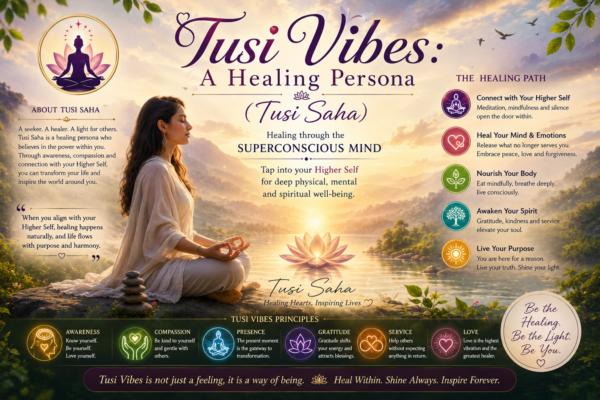
Tusi Vibes: A Healing Persona — Awakening the Superconscious Mind Through the Higher Self
Tusi Vibes: A Healing Persona (Tusi Saha)
Healing is often viewed as a process of treating symptoms, overcoming emotional wounds, or restoring physical health. Yet many spiritual and psychological traditions suggest that true healing begins much deeper—within consciousness itself. “Tusi Vibes: A Healing Persona” represents an approach to life that seeks harmony by awakening the superconscious mind, the aspect of awareness associated with intuition, creativity, compassion, wisdom, and a profound sense of inner unity. Rather than being a medical treatment, this perspective encourages individuals to cultivate a deeper relationship with what many traditions call the Higher Self, allowing healing to emerge as a transformation of the whole person. Contemporary psychological discussions, including the field of psychosynthesis, describe the superconscious as a dimension of human experience linked with higher values, insight, and meaning, while emphasizing that these ideas remain philosophical and spiritual rather than established medical science.
The name “Tusi Vibes” symbolizes more than a personality. It reflects an atmosphere of calmness, authenticity, empathy, and positive presence. Every individual radiates emotional energy through thoughts, words, actions, and intentions. A healing persona is not someone who possesses supernatural powers but someone whose presence naturally inspires peace, confidence, hope, and emotional safety. Such individuals often become sources of encouragement because they cultivate patience instead of judgment, understanding instead of criticism, and compassion instead of fear. Their greatest influence comes not from what they say but from how they live.
The foundation of this healing philosophy lies in the belief that human consciousness operates on multiple levels. The conscious mind processes immediate experiences and logical thinking, while the subconscious stores memories, habits, emotions, and learned behaviors. Beyond both, many spiritual traditions and transpersonal psychological models describe a superconscious dimension that is associated with moments of profound intuition, creative inspiration, unconditional love, and experiences of transcendence. Although these concepts are widely discussed in spirituality and some branches of psychology, they are not universally accepted as empirically verified scientific constructs.
The Higher Self is often described as the wisest aspect of one’s being. Unlike the ego, which reacts from fear, insecurity, or personal desire, the Higher Self is believed to respond with clarity, balance, and purpose. Many people report experiencing glimpses of this state during deep meditation, silent reflection, creative expression, acts of selfless service, or profound moments in nature. Whether interpreted spiritually or psychologically, these experiences frequently leave individuals feeling more connected, resilient, and compassionate.
Physical healing is often influenced by mental and emotional well-being. Scientific research increasingly recognizes that chronic stress, anxiety, and persistent negative emotions can affect sleep, immune function, cardiovascular health, and overall quality of life. Practices such as mindfulness meditation, controlled breathing, gratitude, and stress reduction have demonstrated measurable benefits for many people. While proponents of superconscious healing may attribute these benefits to connecting with the Higher Self, it is important to distinguish between spiritual interpretation and medical evidence. Spiritual practices can complement healthcare, but they should not replace appropriate medical diagnosis or treatment.
Mental healing begins when individuals become observers rather than prisoners of their thoughts. The healing persona recognizes that every negative belief is not necessarily a permanent truth. Fear, guilt, anger, and self-doubt often arise from conditioned experiences rather than one’s deepest identity. Through conscious awareness, individuals gradually learn to release limiting beliefs and replace them with acceptance, forgiveness, courage, and purpose. This process resembles the psychological goal of integrating different aspects of the self into a healthier whole, a concept emphasized in transpersonal approaches such as psychosynthesis.
Emotional healing requires the courage to experience emotions without becoming controlled by them. Rather than suppressing pain, disappointment, or grief, a healing persona allows emotions to be acknowledged, understood, and transformed. Compassion toward oneself becomes as important as compassion toward others. Over time, emotional resilience develops not because life becomes easier but because the individual responds with greater wisdom and stability.
Spiritual healing extends beyond personal happiness. It involves discovering meaning, purpose, and connection with something larger than oneself. Different cultures describe this connection in different ways—God, Divine Intelligence, Universal Consciousness, Pure Awareness, or the Higher Self. Regardless of terminology, many contemplative traditions emphasize that cultivating humility, gratitude, service, and inner stillness can deepen a person’s sense of fulfillment and belonging.
Developing the “Tusi Vibes” healing persona is less about acquiring extraordinary abilities than about practicing extraordinary consistency in ordinary life. Daily meditation strengthens awareness. Mindful breathing calms the nervous system. Gratitude shifts attention from scarcity to abundance. Forgiveness releases emotional burdens that consume mental energy. Acts of kindness reinforce empathy and strengthen social connection. Journaling promotes honest self-reflection, while spending time in nature encourages mental restoration and perspective. Individually these habits may seem simple, but together they can profoundly influence how people think, feel, and relate to others.
A genuine healing presence is also reflected in relationships. People naturally gravitate toward those who listen without interrupting, encourage without controlling, and support without expecting anything in return. The healing persona does not seek admiration or authority. Instead, it creates environments where others feel valued, respected, and emotionally safe. Such influence spreads quietly through families, workplaces, communities, and friendships, often producing ripple effects that extend far beyond any single interaction.
Modern neuroscience continues to explore meditation, compassion, mindfulness, and positive emotional states, finding associations with improved attention, emotional regulation, and reduced stress in many individuals. However, claims that connecting with a superconscious mind directly heals disease remain outside mainstream scientific consensus. The most balanced perspective recognizes that spiritual practices may enrich psychological well-being and complement evidence-based healthcare without replacing it.
“Tusi Vibes: A Healing Persona” is a philosophy of becoming rather than achieving. It invites individuals to move beyond fear toward wisdom, beyond reaction toward conscious response, and beyond self-centered living toward purposeful service. Healing, in this view, is not merely the absence of illness but the presence of inner peace, emotional balance, meaningful relationships, compassionate action, and spiritual growth. By cultivating awareness of the Higher Self while remaining grounded in practical self-care and appropriate medical support, individuals can aspire to a more integrated life—one in which physical vitality, mental clarity, emotional resilience, and spiritual purpose work together to create lasting well-being.
Ultimately, Tusi Vibes: A Healing Persona represents an invitation to look inward before seeking outward solutions. It reminds individuals that beneath life’s pressures lies the possibility of greater clarity, resilience, and peace. Whether understood through spirituality, psychology, or personal development, the pursuit of the Higher Self encourages people to cultivate wisdom, live with intention, and approach both themselves and others with greater compassion. While spiritual practices should complement—not replace—appropriate medical and mental health care when needed, they can provide a meaningful framework for personal growth, helping individuals build lives grounded in awareness, purpose, and enduring inner harmony.